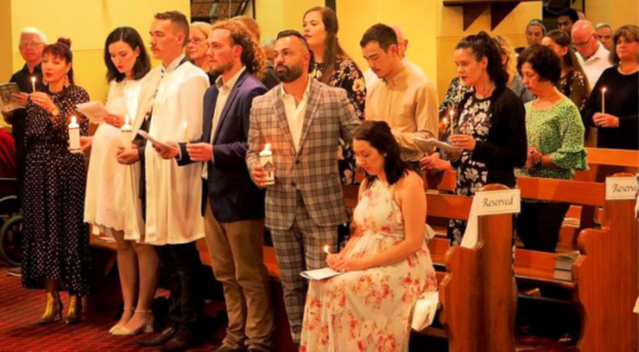
Renewal of Baptism Promises, Easter Vigil 2019, St Francis Xavier Cathedral, Woolongong (NSW)
By Dr. Christine Wood, Director, Office of Evangelisation & Catechesis, Archdiocese of Hobart
The Catechism of the Catholic Church explains the term ‘mystagogy’ as “Liturgical catechesis [which] aims to initiate people into the mystery of Christ… by proceeding from the visible to the invisible, from the sign to the thing signified, from the ‘sacraments’ to the ‘mysteries’” (CCC, 1075).
The Rite of Christian Initiation of Adults (RCIA) identifies the Easter season as the period of ‘mystagogy’, or postbaptismal catechesis, for the newly-baptised neophytes. So what are RCIA teams meant to do with neophytes during this period?
During the Easter season, neophytes are to rejoice in the risen Lord and to begin to practice their Catholic faith in its fullness. According to the Rites book this occurs through “meditation on the Gospel, sharing in the Eucharist, and doing the works of charity” (RCIA 234). The RCIA team helps neophytes develop in these disciplines of the Christian life.
Neophytes should continue the practice of reflecting on the Word of God which they began during the catechumenate. They can connect with parish or family bible studies, or even gather after Sunday Mass to reflect on the readings with their godparents, the RCIA team, and other parishioners. Many Catholic media options exists for parishes to use as options for ongoing faith formation on Scripture, the Christian life, and prayer (e.g. www.formed.org). These are all different ways the whole parish can get involved in the RCIA process to help the neophytes grow in their personal identity as Catholics and in their relationship with God.
The primary way neophytes are able to grasp the paschal mystery of Christ is the celebration of the Eucharist itself. The Eucharistic liturgy is the source and highpoint of the Christian life because it is where we encounter the crucified and risen Lord and renew the new covenant in his blood. The intimate communion with Christ in the Eucharist will be the ultimate source of interior teaching and nourishment for neophytes. But liturgical catechesis is still required to unpack the meaning of the liturgy in order that they may engage in the liturgy in a mature manner. This catechesis involves reflection on the liturgical rites and Scriptures, and connecting them to the post-baptismal life of the neophytes.
We need to let the liturgy teach and form the neophytes in the way appropriate to it. There is no need to try to alter or manipulate the sacred Rites and ceremonies in order to try to make them more meaningful. They are meaningful in themselves. We simply let the Holy Spirit work through the liturgy.
Homilies during the Easter season should take into account the presence and needs of the neophytes by focusing on baptism and the other sacraments of initiation. Homilists can remind both neophytes and the rest of the faithful how they can live out their baptismal apostolate in both word and deed.
During the period of mystagogy neophytes are guided to engage in Christian disciplines like personal and communal prayer, devotions, daily examination of conscience, and to make frequent use of the sacrament of Reconciliation. Besides the Mass itself, arguably the chief discipline to foster is a love for contemplating the central mystery of the Church through Eucharistic adoration. Simply sitting with the Lord during Eucharistic adoration facilitates the movement from the visible sign (bread that nourishes) to the invisible mystery of Christ’s presence and action. Eucharistic adoration provides the perfect opportunity to develop a relationship with Christ embodied in the Eucharist, which is so important for Catholics living this side of our heavenly home.
If they haven’t done so in the catechumenate, this is a time for RCIA teams to encourage neophytes to become involved in various forms of parish service, or works of charity. In this way, they learn to live the ‘law of love’ in the world. Such works include parish outreach to the homebound, nursing homes, and homeless; volunteering at pregnancy help centres; family groups to help struggling mothers or the elderly; children’s catechesis, and other works of evangelisation.
In all of these activities, neophytes are lead to discover the invisible in the visible: to discern the connection between the Word proclaimed and the Word made flesh in the Eucharist; to see Christ in each person, especially the poor and vulnerable; to be drawn into the whole life of the Church, seen and unseen.
