By Deacon Michael Moore, a RCIA Parish Coordinator in the Archdiocese of Adelaide and executive member of CIAN
This article is in response to the question below, and others, put to me by the Editor of the Brisbane “Liturgy News”.
“It is clear that many parishes are struggling to integrate people into the Community after initiation when those involved in RCIA ministry are tired and already starting to work with new people”.
It would appear that parishes experiencing this issue are really talking about the number of Neophytes who go through the RCIA process, receive the Sacraments at the Easter Vigil Mass and then during the period of Mystagogy the numbers fall away and in fact some are rarely seen at Mass again.
Officially, the Mystagogy Period is seven weeks between Easter and Pentecost. However, because the RCIA is most successful when enough time is allowed to ensure the Catechumens/Candidates are ready to receive the Sacraments, we need to adopt a year-round process that would enable this.
Paragraphs 234-241 of the Rite reminds us that mystagogy includes integration into the parish community, doing works of charity and engaging in pastoral aspects of parish life.
Because the Neophytes have been involved in works of charity and other works within the community prior to the Easter ceremonies, the main focus of the period of mystagogy is their deepening participation in the Eucharist.
The success of the period of mystagogy is entirely dependent on everything that has proceeded it.
Therefore, there are four things I believe must be considered:
- Would the RCIA benefit from being a year-round catechesis?
- Important Questions for the Enquirer/Seeker.
- Is the Rite being used effectively?
- Can we make better use of the faith community to enable successful integration of the neophytes and the newly received into communion?
The Year-round Process
The RCIA is not a one size fits all process. RCIA is a liturgical, catechetical and pastoral process that requires signs and stages of conversion to take place before the participant progresses to the next stage, that is, from the Enquiry to the Catechumenate, for example. This provides for a process that allows a person who is not ready to progress to remain in one period of the process whilst another might move onto the next period of the process. This can be facilitated by a year-round process.
Too often parishes have operated the RCIA processes from a “group” perspective assuming that everyone in the group is at the same place, and they all have the same goals. However, we have learnt, over time, that these assumptions are not correct. By discounting the experiences that the enquirers have acquired, we are ignoring their previous life and faith experiences, and may risk leading them on an inappropriate path of initiation.
The year–round process allows new enquirers to join the process at any time and remain in it until they receive the sacraments. This method could be difficult for a single team and perhaps a second team might be required so that enquirers are not disadvantaged in any way.
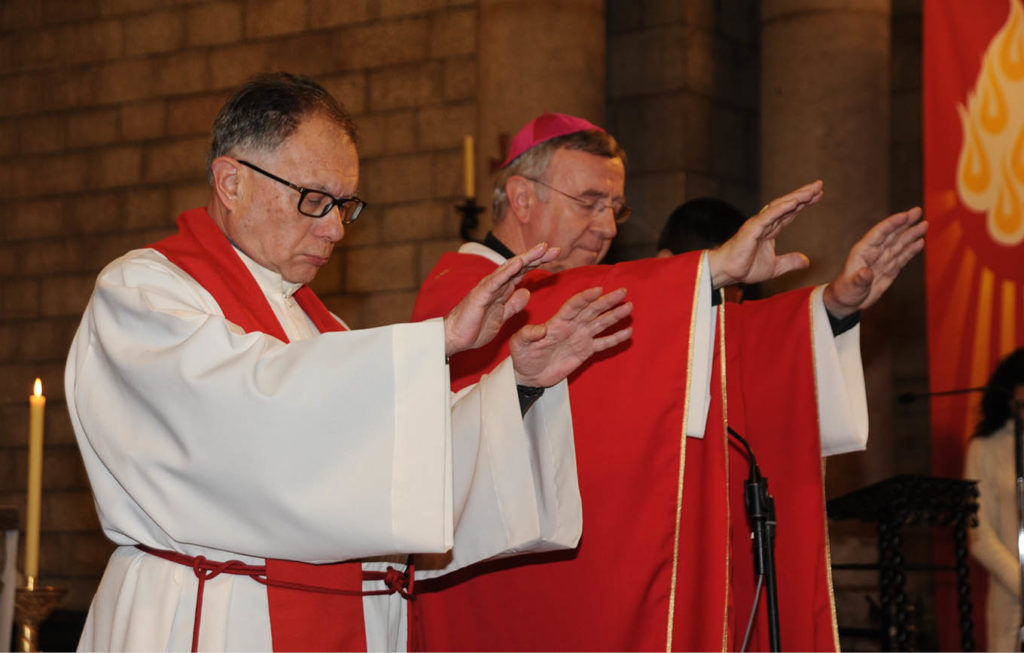 Image by Daforo on Cathopic
Important Questions
Nick Wagner is one of the co-founders of TeamRCIA, an American group who run many seminars on aspects of the RCIA, and provide subscribers with a large amount of reading materials. He has devised a series of five questions which he recommends the parish RCIA Team Leader uses to help the Enquirer/Seeker determine their readiness to make the commitment to see if the Catholic faith is what they are searching for. These questions are asked in a one on one situation by the Team Leader before the Enquirer is accepted into the process.
Briefly, the questions might be similar to the following and may be obtained at TeamRCIA.com:
- Where have you been?
- Where are you now?
- Where would you like to get to?
- How are you going to get to where you want to be?
- How will you know you have arrived?
The questions are designed to discover whether the Enquirer has a spiritual life, where is God in their life and more personal things as well. The questions continue to probe into aspects like their goals in being part of RCIA, how will they fit into the parish, how do the hope to achieve their goal and what signs will indicate that they have arrived at their goal.
As an RCIA Coordinator, I have used questions of this nature for some time. I also provide the Enquirer with a Journal so that they can keep a record of their achievements as well as reflections on the meetings and questions they might have as a result of something that occurred between meetings that they would like to know more about. So, I get to know them and what they are looking for, whilst they will get to know me and the Team and learn from us what it is going to take for them to complete the process.
Perhaps the most important element of this approach is that it now places the responsibility on the seeker, not the catechists. No longer are we pushing them through a course of study, but rather we are on a journey with them.
Is the Rite being Used Effectively?
The roles and responsibilities of the faithful are set out in the section “Ministries and Offices” – RCIA 9 – RCIA16. These are among the most important statements as to how the RCIA process is conducted. It is clearly stated that the initiation of adults is the responsibility of all the baptised (see#9). The rite then continues:
“Therefore the community must always be fully prepared in the pursuit of its apostolic vocation to give help to those who are searching for Christ.”
RCIA 9: then goes further in stating that all the followers of Christ have an obligation of spreading the faith according to their abilities and the entire community must help the candidates and the catechumens throughout the process of initiation. It then lists a number of responsibilities the entire community must be responsible for, including that the faithful should take part in the Mass for neophytes, the Sunday Masses of the Easter season and welcome the neophytes with open arms in charity, and help them to feel more at home in the community of the baptised.
RCIA 10: talks about sponsors. The introduction to the Rite makes a distinction between the sponsor and the godparent. The sponsor accompanies the catechumen through the Rite of Acceptance and the Catechumenate. The godparent accompanies the catechumen on the day of Election through the periods of purification and enlightenment, the celebration of Initiation and the period of Mystagogy.
The role of sponsor is an active one that includes:
- Presenting the enquirer to the parish community and attesting to his/her sincerity at the Rite of Acceptance.
- Participating with the catechumen/candidate at all the liturgical rites of the Catechumenate.
- Offering support, encouragement and explanations, when appropriate, for the catechumen/candidate.
- Witnessing to the catechumen’s/candidate’s moral character, faith and intention.
- Providing a link with the parish community.
- Assisting in the discernment process of the catechumen/candidate.
In order to fulfil these roles adequately, the sponsor should participate regularly in catechetical sessions (excluding Sunday dismissals) with the catechumen/ candidate. It is recommended that the catechumenate team select sponsors. It is necessary that sponsors be identified and in place well in advance of the Rite of Acceptance since sponsors must attest to the candidates’ readiness, etc.
RCIA 11: The role of the godparent begins with the Rite of Election and continues through the candidate’s baptismal life. As with the sponsor’s role, the godparent’s role includes active involvement with the elect, while offering support and encouragement. Since the role of the godparent is one defined by canon law, he or she must be fully initiated in the Roman Catholic Church (Baptism, Confirmation, Eucharist), not be a parent of the candidate, not be bound by a canonical penalty and be living a life consistent with the faith and responsibility of a godparent.
RCIA 16: The catechists in the RCIA process must have a thorough knowledge of and love for the teachings of the Church as well as the practical skills necessary to work effectively with adults and/or children. Catechists who work with adults should understand the principles of adult learning; those who work with children should apply teaching skills that are appropriate to the age of the children.
RCIA is intimately bound up with the liturgical life of the Church and draws substantially on the Scriptures proclaimed in the Sunday Mass. Therefore, catechists need to have solid grounding in principles of good liturgy, Scripture, basic Catholic doctrine and spirituality.
The catechist who works in the RCIA must have a special responsibility of witnessing to the principles of ecumenism and interreligious cooperation and worship.
Early Integration of Neophytes and the Newly Received
The foregoing discussion is a necessary precursor to this section on early integration of the Neophytes. As stated earlier, the RCIA process is not a one size fits all process. Neither is it a process that must be totally conducted by the parish RCIA Team. The Rite of RCIA provides for many others to be involved in the process. The Team should use them as much as possible.
The document from Vatican II, called the ‘Decree on Missionary Activity of the Church’, says this:
“Those who have received from God the gift of faith in Christ, through the Church, should be admitted with liturgical rites to the catechumenate which is not a mere exposition of dogmatic truths and norms of morality, but a period of formation in the whole Christian life, an apprenticeship of sufficient duration, during which the disciples will be joined to Christ their teacher.” (Ad gentes, #14)
Vatican II made it quite clear that RCIA is not just “a mere exposition of dogmatic truths and norms of morality, but a period of formation in the whole Christian life.”
Could we imagine a young person entering into an apprenticeship and then spending most of their time in a class room learning from books about the trade they are wanting to be involved in? That is not how it works. An apprentice is employed by a qualified tradesperson who provides tools of trade and work, so the apprentice can hone their skills and become a qualified tradesperson. They may experience different job sites and be involved in different projects from time to time, so they develop a wide range of skills.
A person wishing to become a Catholic, can learn from attending weekly meetings, presentations and readings. But will they learn to live the Christian way? Like an apprentice, they need to get some hands-on experience, by doing what Christians do over and over until they are recognised as Christian.
“The period of the catechumenate should be long enough – several years if necessary – for the conversion of faith of the catechumen to become strong. By their formation in the entire life and sufficiently prolonged probation the catechumens are properly initiated into the mystery of salvation and the practice of an evangelical way of life.” (RCIA 76)
If we wish to retain and integrate those new to the Catholic way of life we need to get out of the meeting rooms and let them experience what it is Catholics do. Catechumens and Candidates should be given the opportunity to meet members of the parish community and to take part in parish activities. Participation in parish activities, where appropriate, and in the mission of the Church, should not be unduly delayed until after sacramental initiation, but can begin anytime during formation under the guidance of the godparent/sponsor.
